
Welcome
The Internet is constantly changing: new protocols are designed to improve services, e.g., performance, security, or service flexibility. While Internet protocols are designed according to formal specifications, their real-world deployment often diverges in subtle but important ways. This raises questions about how the Internet adapts to new protocols and the increasing complexity, and about whether design goals are met or can be further improved on. My research at the Max Planck Institue for Informatics focuses on understanding the Internet as a large-scale, evolving system through empirical measurement and data-driven analysis. I currently focus on the evaluation of the behavior of new protocols, e.g., QUIC, due to their increasing complexity, and their behavior within the network in addition to existing protocols. My research is based on three pillars: (i) Internet measurements to identify and evaluate services, (ii) the development and evaluation of endpoint behavior to effectively make use of new protocols, and (iii) the evaluation and improvement of protocol behavior. My work has informed both the research community and practitioners about the current state of the Internet ecosystem. I regularly publish at leading networking venues such as ACM IMC, CoNEXT, and PAM.
Previously, I did my PhD at the Chair of Network Architecures and Services at the Technical University of Munich.
I am co-leading the Global Internet Observatory (GINO), an interest focusing on Internet measurements. Over the years, we acquired vast knowledge in the area of large scale network measurements. This helps us to understand the current network state and its development. We seek to be harmless and conduct all measurements in an ethical manner.
Recent News
IMC 2026: TTL Jumps
Our paper “TTL Jumps: Unexpected TTL Rewrites Impacting Inferences from Traceroutes” was accepted at IMC’26.
We show that TTL jumps exist on the Internet: some devices rewrite the TTL, often to larger value of up to 255. These rewrites hide the remaining path from traceroute and can lead to incorrect inferences like spurious router and Autonomous System (AS) links. Based on controlled experiments and public data from RIPE Atlas and CAIDA Ark, we show that at least 47 ASes are impacted by path-impairing devices that rewrite the TTL.
NOMS 2026: Kernel Bypass
Our paper “Kernel Bypass Surgery: A Viable Procedure for Maximizing QUIC Bandwidth?” was accepted at NOMS’26.
We investigate the impact of kernel bypass on performance. We integrated the Data Plane Development Kit (DPDK) into three QUIC implementations, bypassing their use of the kernel networking stack, and updated a fourth stack that previous work combined with DPDK. Our analysis shows that kernel bypass can greatly increase the goodput achieved with QUIC, with a speedup reaching up to a factor of 3× and goodput over 10 GBit/s. However, the reachable performance increase highly depends on the implementation, and in one case performance did also not further increase when using DPDK. All implementations and artifacts are available.
KuVS Dissertation Award
My dissertation “Detecting and Evaluating QUIC Deployments as Part of the Internet Ecosystem” was awarded the KuVS Dissertation Award 2025.
Max Planck Institue for Informatics
After five successful years as PhD student at the Technical University of Munich, I started a new position at the Internet Architectures group at the Max Planck Institute for Informatics.
IPv6 Hitlist Extension
Two weeks Lion Steger presented our latest insights and extensions to the IPv6 Hitlist Service at TMA 2023 and received the best paper award. The work categorized the Hitlist based on network types and evaluated target generation algorithms under different conditions. The paper is avaialable for more information. We further added a new historic and ongoing categorization as part of the Hitlist service for everybody to use. New responsive addresses will also be visible shortly.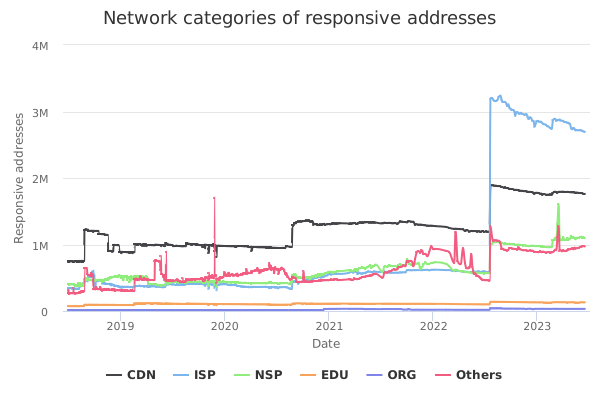
Selected Publications
The Internet’s Path MTUs: How Big Can You Go?
Jonathan Binkle, Vaishnavi Raghavajosyula, Tiago Heinrich, Anja Feldmann, Tobias Fiebig, Johannes Zirngibl, "The Internet’s Path MTUs: How Big Can You Go?." Proc. ACM Int. Measurement Conference (IMC), 2026.
TTL Jumps: Unexpected TTL Rewrites Impacting Inferences from Traceroutes
Sebastian Kappes, Anja Feldmann, Tobias Fiebig, Johannes Zirngibl, "TTL Jumps: Unexpected TTL Rewrites Impacting Inferences from Traceroutes." Proc. ACM Int. Measurement Conference (IMC), 2026.
Punching Bag: A Tool for Testing IPv6 Scans and Target Generation Algorithms
Lion Steger, Christian Junginger, Georg Carle, Johannes Zirngibl, "Punching Bag: A Tool for Testing IPv6 Scans and Target Generation Algorithms." Proc. ACM Int. Measurement Conference (IMC), 2026.
A QUIC Look Back: Longitudinal Internet-Scale Deployment and Transport Parameter Evolution
Marcel Kempf, Nikolas Gauder, Johannes Späth, Georg Carle, Johannes Zirngibl, "A QUIC Look Back: Longitudinal Internet-Scale Deployment and Transport Parameter Evolution." Proc. ACM Int. Measurement Conference (IMC), 2026.
Lazy Eye Inspection: Capturing the State of Happy Eyeballs Implementations
Patrick Sattler, Matthias Kirstein, Lars Wüstrich, Johannes Zirngibl, Georg Carle, "Lazy Eye Inspection: Capturing the State of Happy Eyeballs Implementations." Proc. ACM Int. Measurement Conference (IMC), 2025.
QUIC Steps: Evaluating Pacing Strategies in QUIC Implementations
Marcel Kempf, Simon Tietz, Benedikt Jaeger, Johannes Späth, Georg Carle, Johannes Zirngibl, "QUIC Steps: Evaluating Pacing Strategies in QUIC Implementations." Proc. ACM Netw., 2025.
ECSeptional DNS Data: Evaluating Nameserver ECS Deployments with Response-Aware Scanning
Patrick Sattler, Johannes Zirngibl, Fahad Hilal, Oliver Gasser, Kevin Vermeulten, Georg Carle, Mattijs Jonker, "ECSeptional DNS Data: Evaluating Nameserver ECS Deployments with Response-Aware Scanning." Proc. ACM Netw., 2025.
QUIC Hunter: Finding QUIC Deployments and Identifying Server Libraries Across the Internet
Johannes Zirngibl, Florian Gebauer, Patrick Sattler, Markus Sosnowski, Georg Carle, "QUIC Hunter: Finding QUIC Deployments and Identifying Server Libraries Across the Internet." Proc. Passive and Active Measurement (PAM), 2024.
Towards a Tectonic Traffic Shift? Investigating Apple's New Relay Network
Patrick Sattler, Juliane Aulbach, Johannes Zirngibl, Georg Carle, "Towards a Tectonic Traffic Shift? Investigating Apple's New Relay Network." Proc. ACM Int. Measurement Conference (IMC), 2022.
Rusty Clusters? Dusting an IPv6 Research Foundation
Johannes Zirngibl, Lion Steger, Patrick Sattler, Oliver Gasser, Georg Carle, "Rusty Clusters? Dusting an IPv6 Research Foundation." Proc. ACM Int. Measurement Conference (IMC), 2022.
It`s over 9000: Analyzing early QUIC Deployments with the Standardization on the Horizon
Johannes Zirngibl, Philippe Buschmann, Patrick Sattler, Benedikt Jaeger, Juliane Aulbach, Georg Carle, "It`s over 9000: Analyzing early QUIC Deployments with the Standardization on the Horizon." Proc. ACM Int. Measurement Conference (IMC), 2021.